Deterministic rewrites
Templates map each supported stack to vetted Dockerfile structures so diffs remain predictable and auditable.
See template catalog →Container Dietitian · Built for offline review rooms
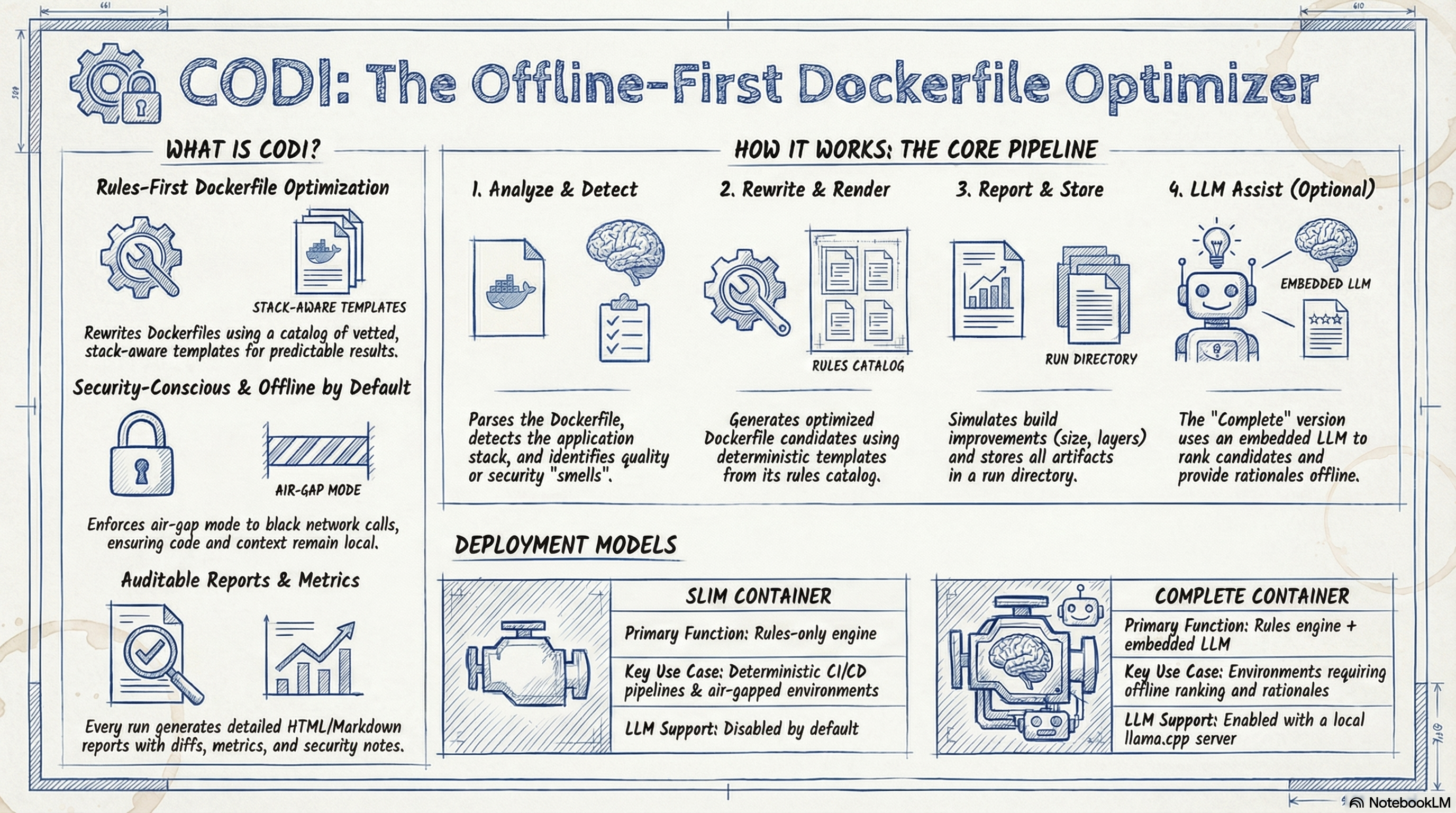
CODI pairs stack-aware templates with an embedded llama.cpp module so you can analyse, rewrite, and justify Dockerfile improvements without touching the public internet. Every recommendation ships with metrics, diffs, and policy notes ready for a hackathon board review.
We grounded every page in the official CODI documentation. The site follows the same blueprint aesthetic as the provided one-pager while surfacing the highlights reviewers care about.
Templates map each supported stack to vetted Dockerfile structures so diffs remain predictable and auditable.
See template catalog →Air-gap mode blocks outbound calls, enforces adapter allowlists, and keeps data local for compliance reviews.
Review security guide →Every CLI run emits Markdown + HTML reports, JSON artefacts, and change rationales for scoring.
Inspect reporting stack →The Complete container ranks candidates and produces rationales without sending Dockerfiles to the cloud.
Dive into LLM module →The four-stage pipeline mirrors the notebook-style blueprint. Each stage links directly to the supporting documentation so reviewers can verify the implementation.
Parse Dockerfiles, detect stack + quality smells, and snapshot metadata for reports.
CLI Guide →Use the rules catalog to generate deterministic candidates with inline policy notes.
Rules Guide →Simulate build impacts, capture metrics, and store artefacts under `runs/`.
Reporting →Embedded llama.cpp ranks candidates and drafts rationales entirely offline.
LLM Module →The Complete container layers llama.cpp on top of the Slim rules engine. Reviewers can see exactly how adapters are mounted, validated, and audited.
/models with checksum validation.LLM_ENABLED and LLM_ENDPOINT.Deterministic engine for CI pipelines and air-gapped stages. LLM disabled, outbound traffic blocked.
Bundles llama.cpp, adapters, and ranking services for onsite LLM rationale without cloud calls.
Every Markdown file in docs/ is now a first-class web page. Use the curated entry points below to jump into the area you care about.
INTRODUCTION · INSTALLATION · QUICK_REFERENCE
Start with the overview →ARCHITECTURE · TECH_STACK
System architecture →OPERATIONS · SECURITY · CICD_RELEASE
Operations guide →PERFORMANCE · TESTING · CONTRIBUTING · REFERENCE
Reference manual →Follow the exact steps in INSTALLATION.md or run the Slim container using the documented commands.
Verify install →Use REPORTING.md + site-map to trace where every HTML/JSON file lands after a `codi run`.
Review artefacts →The new DEPRECATION_NOTICE.md shows how legacy notes map to this release to simplify scoring.
See mapping →The visual language matches the supplied one-pager so the experience feels cohesive from pitch deck to live demo.
Open the reference image